

How Baseball Analytics Changed the Way I See Human Performance
From the Bullpen to Biometrics — What the Rays and Youth Baseball Taught Me About the Future

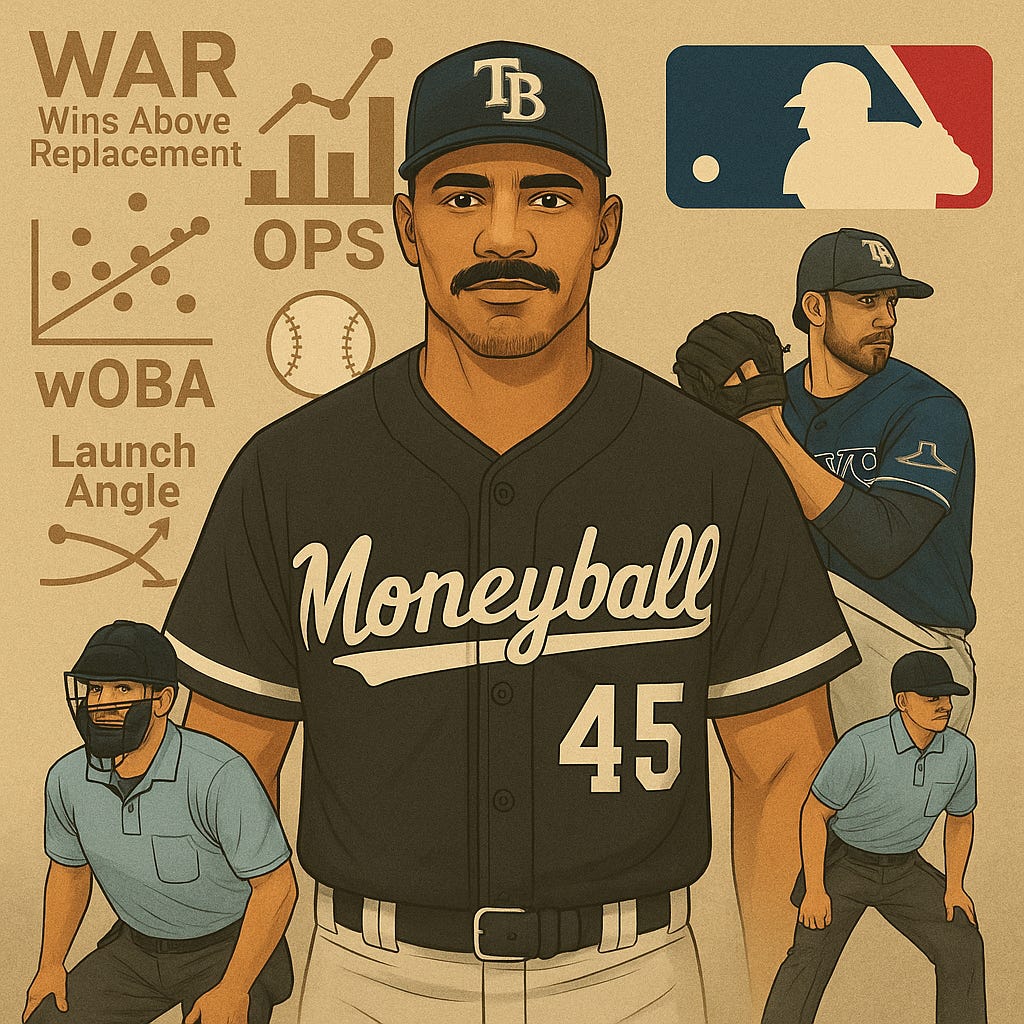
Lately, I’ve been spending a lot of time around the game of baseball, more than I ever expected.
I work security for the Tampa Bay Rays, often stationed near the bullpen or field. And the more time I spent there, the more something started clicking. One night, I watched them roll out five or six pitchers in a single game. I remember thinking:
"What’s going on here? I thought it was starter… then reliever… maybe a closer?"
I was used to the old-school rhythm. But this was something else. This was high-level chess.
It was matchups.
Lefty-on-righty. Righty-on-lefty.
A specialist for a two-hitter stretch.
Pulling a starter early because the analytics said third time through the order, his ERA spikes.
It wasn’t about ego. It was about maximizing every pitch. I started digging, learning about leverage index, barrel percentage, chase rate, wOBA splits, and it opened my eyes. This wasn’t randomness—it was precision.
At the same time, I was also umpiring youth baseball on weekends. That brought me even closer to the game, relearning the rules, enforcing them, and seeing the game through the lens of structure and flow.
So between being at the professional level and guiding the grassroots level, something changed. I fell in love. And not with nostalgia, but with how baseball thinks.
As someone who came up through football, whose DNA is built around aggression, power, and momentum, this was different.
Baseball became the first sport I truly fell in love with as an adult.
And what I saw in the game aligned perfectly with what I’ve been building in the lab.
⚙️ The Birth of Sabermetrics: A Quiet Revolution
Baseball was one of the first sports to go all-in on analytics—and it flipped everything.
The revolution started with Bill James and the rise of sabermetrics—a term built from SABR (Society for American Baseball Research). At its heart, sabermetrics was about this question:
What if everything we think we know about player value… is wrong?
Front offices started asking:
Why are we paying for batting average when on-base percentage tells a better story?
Should we care about a pitcher’s ERA, or is FIP (Fielding Independent Pitching) more accurate?
Can we project performance based on exit velocity, launch angle, and xwOBA?
Enter Moneyball.
Enter the Oakland A’s.
Enter an entire movement around efficiency, matchups, and value.
And today? It’s not even up for debate. Every front office is a hybrid of baseball lifers and data scientists. The best teams aren’t just talented—they’re calculated.
The Rays? They’re masters at it.
Pulling a starter with 75 pitches because the numbers say he drops off in the 6th.
Using a reliever as an opener to flip the batting order.
Deploying platoon advantages across the entire lineup based on pitcher profile, swing mechanics, and fatigue.
It's not luck. It's optimization.
📊 What I Saw in Baseball Is What I Built in HyperSpeed
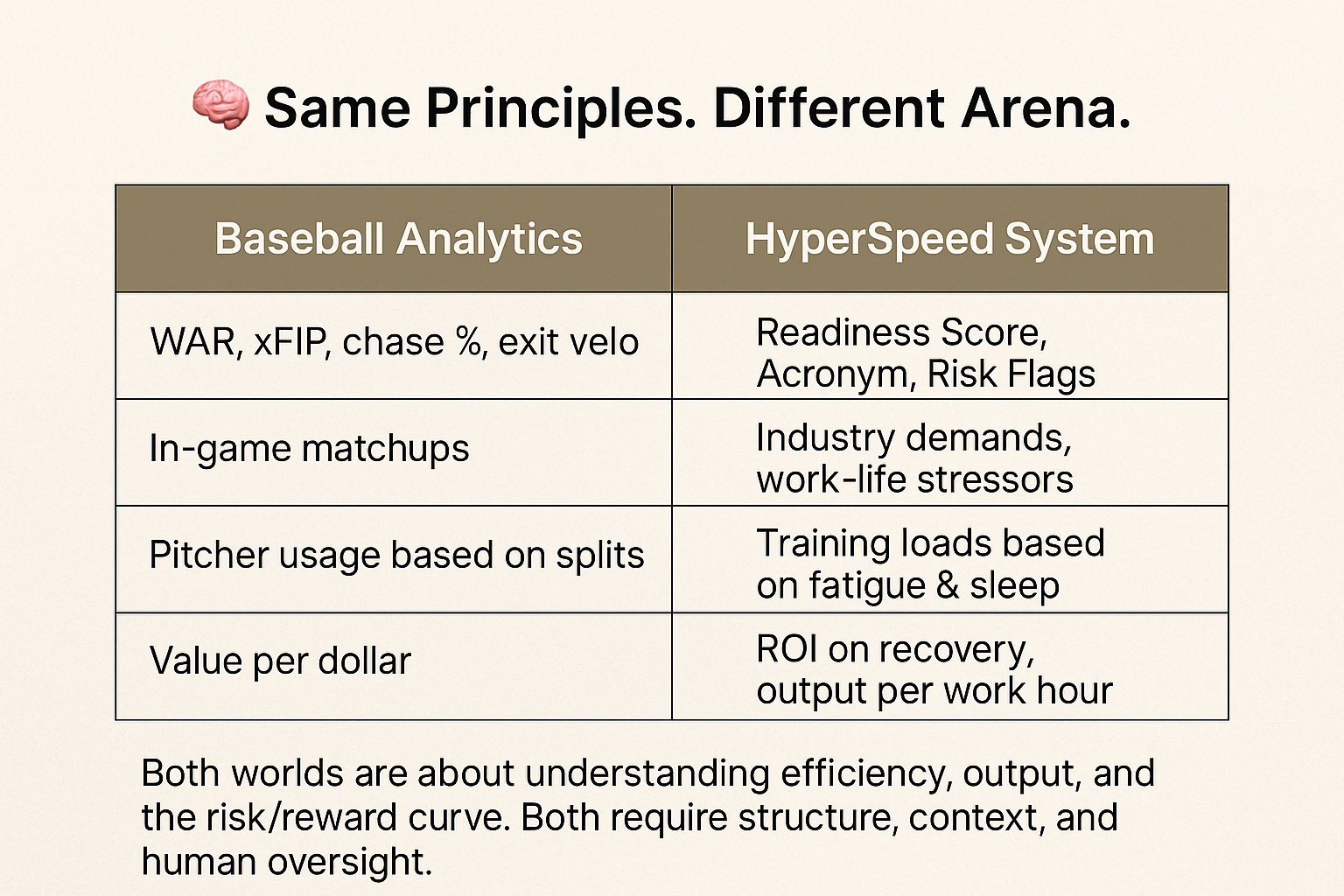
The same way baseball is using data to squeeze out wins, I’ve been using data to squeeze out performance and readiness in everyday people, athletes, workers, teams, organizations.
HyperSpeed is a human performance intelligence system.
We start with a structured assessment, gathering data on:
Age, weight, height, injury history
Sleep habits, work hours, activity levels
Industry or sport-specific demands
Physical & cognitive stress
Biometric metrics (InBody, Kinotek, wearables)
From there, we generate a Performance Acronym, flag risks, benchmark metrics, and create a Functional Operating Capacity Score, a kind of WAR for real life.
If baseball uses analytics to decide who plays and when,
HyperSpeed uses analytics to decide how you train, how you recover, and when to push or pull back.
It’s not about grinding 24/7.
It’s about being ready when it counts.
🧠 Same Principles. Different Arena.
🏁 Final Word: Data is a Tool. Humans Make the Call.
Working security behind the bullpen showed me how strategy replaces ego when the stakes are high.
Umpiring youth games reminded me how rules and structure build trust.
Studying baseball analytics taught me that data is power, but only in the hands of the disciplined.
And building HyperSpeed confirmed it all:
You don’t need to guess anymore. You just need to measure what matters, and act on it with intention.
We’re still in the early innings.
But the vision is real.
And the game has never looked clearer.
– Antone G. Wilson
Founder, HyperSpeed Performance Technologies
Health Intelligence | Security Ops | Athlete Development